



11 Key Differences Between Boom Trucks and Truck-Mounted Cranes
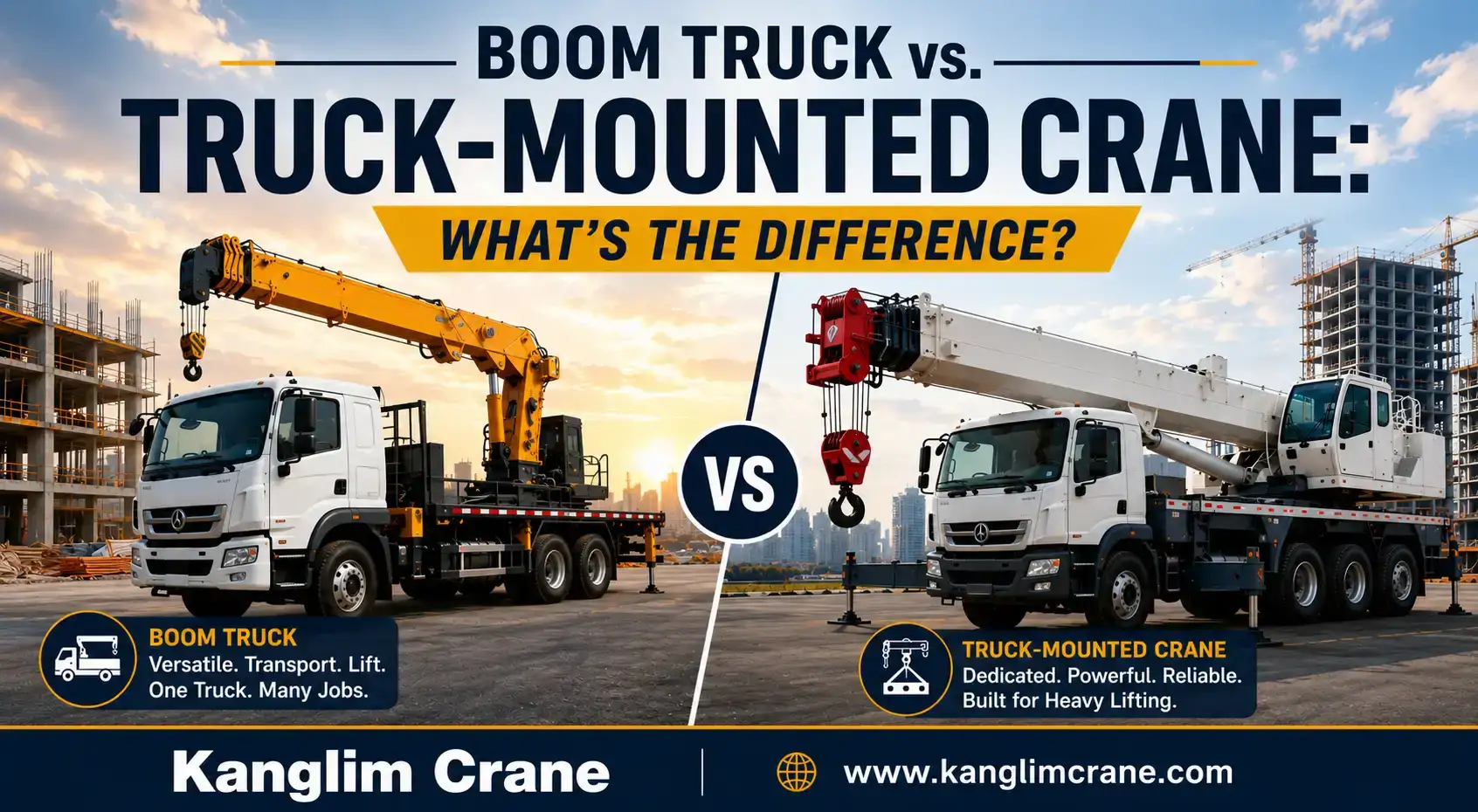
When people look at heavy machines on construction sites, they often get confused between a boom truck and a truck-mounted crane. Both vehicles have a large mechanical arm that lifts heavy items high into the air. However, these two machines are built differently and serve very different purposes on a work site. Choosing the wrong machine for a job can lead to wasted money, project delays, and dangerous working conditions.
A boom truck starts with a standard commercial truck frame. Workers mount a hydraulic crane directly onto this truck chassis, and the vehicle often includes an open flatbed deck in the back. On the other hand, a truck-mounted crane is built from the ground up as a heavy-duty lifting machine. It uses a custom-designed carrier chassis that supports massive lifting power without needing cargo space.
This guide breaks down every difference between these two machines. You will learn how their structural design, lifting capacity, job site mobility, and setup requirements set them apart. By understanding these key factors, fleet managers and contractors can pick the exact right equipment for their next project.
01. Core Definitions and Conceptual Overview
Understanding the fundamental identity of each machine prevents costly mistakes on the job site. Engineers classify these vehicles based on whether they prioritize daily transport utility or industrial-strength hoisting power.
1.1 What is a Boom Truck?
A boom truck combines a standard commercial truck chassis with a hydraulic crane system and an integrated flatbed deck. This design allows the vehicle to function as both a transport truck and a lifting tool. Workers can load building supplies, tools, or utility poles directly onto the flatbed deck, drive to the work site at normal highway speeds, and use the mounted crane to unload and lift the materials into place. Buyers sourcing a China boom truck usually look for this dual-purpose design first, since it removes the need for a separate delivery vehicle on every job.
1.2 What is a Truck-Mounted Crane?
A truck-mounted crane is a specialized, heavy-duty lifting machine built on a custom carrier chassis. The entire vehicle is engineered from the factory to support a large crane superstructure. Unlike a boom truck, this machine does not carry cargo on its back. Every part of its structural design focuses on balancing heavy loads, providing strong lifting power, and ensuring stability during complex industrial construction projects.
1.3 Key Distinction Summary
The core split between these two vehicles comes down to utility versus dedicated power. A boom truck offers multi-purpose versatility for tasks across multiple stops. A truck-mounted crane provides dedicated, high-capacity hoisting for single heavy-duty construction sites where safety and lifting weight matter most.
02. Structural and Engineering Differences (Chassis and Design)
The physical skeleton of each vehicle dictates its operational limits and overall strength under heavy loads. Manufacturers use different engineering approaches when building the foundational frame for each machine.
2.1 Chassis Architecture
A boom truck utilizes a standard commercial truck frame purchased from major truck manufacturers. These frames are designed for normal highway driving and general cargo transport, though engineers reinforce specific sections to support the mounted crane. A truck-mounted crane uses a custom-engineered, multi-axle heavy carrier. This specialized frame is built from thick, high-strength steel designed to handle torsional stress and downward pressure during a lift.
2.2 Weight Distribution and Axle Layout
Frame modifications on a boom truck distribute weight across two or three standard axles. The front axle handles steering while the rear dual axles support the weight of the truck body, engine, and crane attachment. A truck-mounted crane uses multiple heavy-duty axles spaced across a longer frame. This multi-axle layout spreads out the weight of the crane and prevents the vehicle from sinking into the ground or violating road weight limits.
2.3 Superstructure Integration
The crane on a boom truck is typically bolted onto the frame as a secondary unit or aftermarket addition. The hydraulic lines and power take-off systems connect to the truck engine to operate the boom. A truck-mounted crane features a fully integrated upper superstructure. The crane tower, hydraulic pumps, and operational mechanics are fused directly into the carrier frame as a single manufacturing process.
03. Lifting Capacity and Performance Metrics
Lifting power determines what kind of materials a machine can safely handle. Engineers measure this capability using maximum weight limits, load radius charts, and boom design.
3.1 Maximum Tonnage Limits Across the Boom Truck Range
A boom truck is not a single fixed-capacity machine. Manufacturers build the same base chassis concept across several tonnage tiers, and contractors choose the tier that matches their daily workload. A mini boom crane truck sits at the lower end of this range and works well for tight residential lots, small signage jobs, and light utility work where a compact footprint matters more than raw tonnage.
A light duty boom truck steps up slightly in capacity while keeping the same fast, single-operator setup, making it a common choice for utility pole work and roofing material placement. A medium duty boom truck adds meaningful lifting power for jobs like HVAC unit installation, small steel placement, and general commercial construction support, without moving into the size and permitting requirements of a full industrial crane.
At the top of this same category sit heavy lifting boom trucks, which retain the flatbed deck and highway drivability of a standard boom truck while pushing tonnage closer to what smaller truck-mounted cranes offer. A truck-mounted crane, by comparison, is not tiered the same way. It is built from the outset for industrial jobs and its lifting capacities extend well beyond the top of the boom truck range, into hundreds of tons for the largest models.
3.2 Load Moment and Radius Degradation
When a crane extends its boom outward away from the vehicle center, the physical leverage changes. A boom truck loses lifting capacity as the boom reaches out because the lighter chassis lacks the structural mass to counteract the pull. A truck-mounted crane maintains a higher load moment and resists tipping better at extended reaches due to its heavier carrier weight and reinforced structural geometry.
3.3 Boom Design Variations
Boom trucks almost always use telescopic hydraulic booms made of nested steel sections that slide in and out smoothly. This keeps the machine compact for road travel and quick to set up. Larger truck-mounted cranes generally use the same telescopic principle at a bigger scale, though some of the largest industrial models add lattice sections for extended vertical reach. Lattice sections use an open steel web framework that provides rigidity over long reaches without adding unnecessary solid steel weight, but they are the exception rather than the rule on standard truck-mounted cranes.
04. Mobility, Transit, and Highway Regulations
Moving heavy machinery from the yard to the job site involves navigating public roads, obeying speed limits, and following legal transport laws.
4.1 Road Drivability and Speeds
A boom truck drives and handles like a regular commercial freight truck. Drivers can travel on public highways, freeways, and city streets at normal traffic speeds without special driving skills. A truck-mounted crane is heavier and bulkier. It requires careful driving, larger turning spaces, and often lower travel speeds because its weight affects braking distance and steering response.
4.2 Permitting and Legal Compliance
Because a boom truck fits within standard commercial vehicle weight classes, it generally needs only standard commercial vehicle registration and basic state licensing. A truck-mounted crane often exceeds normal legal road weight limits and axle load restrictions. Moving this machinery requires special heavy-haul transport permits, advance route planning, and sometimes escort vehicles to guide the machine through public streets.
4.3 Overall Dimensions and Transport Footprint
A boom truck has a standard truck width and height, allowing it to pass under most highway overpasses and through normal toll booths. A truck-mounted crane has a wider body, a longer total length, and a higher profile due to the crane boom resting on top. These dimensions mean the driver must watch for low bridges, narrow lanes, and low-hanging power lines during transit.
05. Job Site Maneuverability and Spatial Footprint
Once a vehicle arrives at a work site, it must navigate around obstacles, workers, and other equipment in a restricted space.
5.1 Spatial Footprint and Dimensions
A boom truck maintains a narrower profile and a shorter overall length. This compact size allows the vehicle to fit into tight commercial zones, crowded parking lots, and narrow street construction zones without blocking entire roadways. A truck-mounted crane requires a larger amount of physical space. Its long body, wide outrigger stance, and large turning radius demand an open and clear working area.
5.2 Navigation and Repositioning Between Tasks
Contractors working in crowded residential neighborhoods or busy downtown areas often rely on agile boom trucks because they navigate sharp street corners easily. A truck-mounted crane struggles in tight spaces and cannot make sharp turns on narrow roads. For jobs that need frequent repositioning within the same site, such as utility line work or multi-point sign installation, a mobile crane truck offers a middle ground. It keeps the tighter turning circle and quicker setup of a boom truck while offering more lifting reach than the smallest boom truck tiers, which suits crews moving between several close positions in a single shift.
06. Stability, Center of Gravity, and Ballast Systems
Lifting heavy loads high into the air requires balance to prevent the vehicle from tipping over. Physics plays a large role in how each machine manages weight and stability.
6.1 Center of Gravity Baseline
A boom truck has a higher center of gravity because the crane sits on top of a standard truck frame that rides high off the ground. This elevated center makes the vehicle less stable during side lifts if outriggers are not used. A truck-mounted crane features a lower, optimized center of gravity with heavy components placed low on the custom carrier frame to keep the machine firmly planted during heavy lifts.
6.2 Outrigger and Stabilization Mechanics
Both machines use hydraulic outrigger legs that extend outward to lift the tires off the ground and create a wide stable base. A boom truck uses standard outriggers that extend straight out or swing down to prevent tipping during moderate lifts. A truck-mounted crane uses heavy-duty, multi-stage outrigger beams with larger steel pads that spread the load weight across a wider surface area.
6.3 Counterweight Management
Boom trucks rarely use removable counterweights because their lifting jobs are lighter and their frames cannot support extra dead weight. Truck-mounted cranes rely on modular steel or concrete counterweights. Workers use auxiliary transport trucks or self-rigging hydraulic systems to load ballast blocks onto the back of the crane carriage before starting a major lift.
07. Setup, Deployment, and Operational Readiness
Time is money on construction sites. The speed at which a machine can arrive, set up, and start working affects daily project efficiency.
7.1 Operational Readiness and Speed
A boom truck offers fast deploy-and-go capability. The operator arrives at the site, drives into position, lowers the outriggers, and begins working within minutes. This speed makes boom trucks a strong fit for contractors who need to visit several different work sites in one day, and it is a large part of why the lighter-capacity tier is so common among utility and maintenance crews.
7.2 Pre-Lift Calibration and Rigging
A truck-mounted crane requires a more detailed setup process before lifting can begin. Operators must check ground stability, place wood or steel support pads under the outriggers, level the machine, and mount the required counterweights. This preparation takes more time but ensures safety during heavy industrial lifts.
08. Cargo Transport vs. Dedicated Lifting Utility
The ability to haul extra items directly to the work site changes how contractors manage logistics and equipment delivery.
8.1 Integrated Flatbed Deck Space
A boom truck features an open flatbed deck located behind the driver cab. This built-in deck space allows contractors to load building materials, tools, safety equipment, and supplies directly onto the truck and haul them to the work site without needing a separate trailer.
8.2 Zero Cargo Capability
A truck-mounted crane provides no cargo transport space. The chassis is dedicated to the crane apparatus, engine mechanics, hydraulic systems, and structural ballast. Contractors must hire a separate flatbed truck to haul construction materials, rigging gear, and outrigger pads to the work site.
09. Operator Environment and Cab Configurations
The place where the operator sits affects comfort, line of sight, and the ability to control the crane safely during long working hours.
9.1 Cab Layout Options
A boom truck typically features a single standard truck cab where the driver sits to steer the vehicle. Some models use this same cab for operating the crane, while others feature a basic swing cab that rotates with the boom turret. A truck-mounted crane usually features a dedicated, independent upper operator cabin that rotates with the crane boom.
9.2 Ergonomics and Visibility
In a boom truck, the operator often looks through standard truck windows or relies on exterior mirrors and hand signals, which can create blind spots during complex lifts. A truck-mounted crane provides an enclosed, climate-controlled upper operator cabin surrounded by glass windows and overhead skylights, giving the operator a clearer view of the load and the work area.
10. Terrain Compatibility and Ground Conditions
Job sites rarely feature perfect flat pavement. Machines must handle rough dirt, gravel, mud, and uneven ground without getting stuck.
10.1 Surface Restrictions and Pavement Performance
A boom truck is optimized for paved roads, concrete highways, and well-maintained commercial work yards. Its standard commercial tires and lower ground clearance perform well on solid, flat surfaces but struggle on loose ground.
10.2 Off-Road Capabilities and Drive Systems
Many truck-mounted cranes come in specialized all-terrain or rough-terrain configurations. These machines feature multi-axle all-wheel steering, larger specialized tires, and higher ground clearance designed to handle muddy, rocky, and uneven ground on major construction sites.
11. Industry Applications and Project Scenarios
Different construction sectors require specialized equipment tailored to the demands of their daily operations.
11.1 Specific Sector Usage and Task Types
Utility companies, tree care services, sign hanging businesses, and residential roofing contractors rely heavily on boom trucks for daily maintenance and installation tasks, often starting with the smallest lifting tier for the lightest jobs and stepping up to a higher-capacity option as load requirements grow. Large commercial builders, bridge engineering teams, and industrial plant contractors deploy truck-mounted cranes for steel erection, high-rise building construction, and major infrastructure projects.
11.2 Project Duration and Scale
Boom trucks excel at short-duration, multi-stop tasks where the crew travels to several different locations in a single day. Truck-mounted cranes are designed for longer projects where the machine remains parked in one spot for weeks or months to handle continuous heavy lifting operations.
12. Conclusion and Comprehensive Summary
Choosing the right lifting machine depends on understanding the strengths of each vehicle. A boom truck offers road mobility, integrated cargo space for hauling materials, and fast setup times for lighter, multi-stop tasks, with capacity tiers that scale from small jobs up to heavier lifts. A truck-mounted crane provides greater structural strength, higher lifting capacities, and specialized stability for heavy industrial construction projects.
Evaluating your project requirements, load weight, site space, and travel distance will help you select the right machine for the job. Choosing correctly keeps your crew safe, prevents costly delays, and keeps your project running smoothly from start to finish.
Still Deciding Which Machine Fits Your Fleet?
Reading through the differences is a good starting point, but the right choice usually comes down to the specific job mix your crew handles week to week. If your team needs one machine that can carry materials, reach tight residential lots, and still scale up for heavier commercial work, Kanglim Crane works with contractors and fleet managers as a boom truck exporter to match the chassis, tonnage, and boom configuration to the actual workload rather than a generic spec sheet. For projects that call for dedicated, higher-tonnage lifting rather than a multi-purpose flatbed setup, our team also supports buyers as a truck crane exporter, helping source the right carrier and boom design before any purchase decision is made.
Talk to our team with your project details, including typical load weight, site conditions, and how often the machine needs to travel between locations, and we will help you land on the configuration that fits.
Featured Articles
A truck crane and a boom truck can look similar from across a job site, both mounted on wheels wi
READ FULLA boom truck looks straightforward from the outside: a
READ FULLSmall, occasional lifts are exactly the kind of work that makes renting feel like the obvious cho
READ FULL